
Your Guide to Tooth Extraction Aftercare: Top 7 Must-Know Do’s and Don’ts After Having a Tooth Pulled

Adult teeth are permanent. However, there are plenty of reasons to undergo a tooth extraction. A dentist may recommend removing a tooth to avoid the risk of infection or to align a patient’s teeth properly. No matter your reason for having a tooth pulled, one thing is certain: being informed and prepared is vital.

According to the American Dental Association, changes will naturally occur in your mouth following a tooth extraction. So, having the right aftercare information is key to preventing complications, promoting healing, and ensuring your comfort.

If you’re getting ready to undergo a tooth extraction procedure soon, this article can be your helpful guide. We’ll briefly cover what to expect once you arrive at your dentist’s office, and then we’ll share essential yet straightforward tooth extraction aftercare tips.

What to Expect With a Tooth Extraction

If you’re getting your permanent tooth pulled for the first time, it’s natural to feel a little anxious. Being informed about what you’re getting into can help ease your nerves and allow you to go into your dentist’s office with a clear head. So, here’s a brief rundown of what to expect once the day of your scheduled tooth extraction arrives:

  • Informing your dentist about your complete medical history is crucial. Undergoing a tooth extraction is generally very safe. However, some conditions put you at risk of developing severe infections. So, be sure to let your dentist know about your medical history, especially if you have heart problems, liver diseases, or an impaired immune system. The dentist may recommend taking antibiotics before and after the tooth extraction.
  • Your dentist will give you a local anesthetic before the procedure. This step numbs the area where the tooth will be removed and prevents you from feeling any pain. Some tooth extraction cases may require a strong general anesthetic, which will make the patient sleep through the procedure.
  • A small amount of bleeding is normal. After a tooth has been removed from its socket, a blood clot will typically form in that area. Your dentist will likely ask you to bite down into a gauze pad to stop the bleeding. In some cases, such as when blood clots break loose, a sedative dressing may also be placed over the socket.

7 Essential Do’s and Don’ts After a Tooth Extraction

Now that you know what to expect during the procedure, let’s talk about what to do after tooth extraction. Proper follow-up care is vital after getting your tooth pulled because it speeds up healing and helps you prevent further discomfort. Here are a few simple tips to make your recovery easier:

#1: DO get enough rest.

You may be tempted to dive back into your daily exercise or workout routine immediately, but resting is vital for helping your body recover and heal. For at least 24 hours after the tooth extraction, limit your physical activity. To be completely safe, don’t do anything too strenuous for the next day or two.

#2: DON’T eat solid foods immediately.

After tooth extraction, it’s best to stick with soft foods like soup, pudding, mashed potatoes, and yogurt for at least 24 hours. You can start adding solid foods back into your diet once your extraction site heals and the numbness in your jaws wear off. In addition, eating hot or spicy foods should be avoided while your mouth is still healing.

#3: DO allow clots to form on the tooth extraction site.

As we previously discussed, your dentist will place a gauze pad over the socket where the tooth was extracted to stop the bleeding and allow blood clots to form. Try to keep the gauze pad in place for at least one hour after the tooth extraction procedure. 

Once your gauze pad has become soaked with blood, change it immediately. Otherwise, leave it be for three to four hours. Also, make sure that you don’t chew on your gauze piece because that may cause more bleeding to occur.

#4: DON’T skip medicines prescribed by your dentist.

Your dentist will likely give you medicines, such as anti-inflammatory drugs, antibiotics, or painkillers, to bring home with you after the tooth extraction procedure. Don’t forget to take the prescribed amount at the right time. These medications will aid your recovery, prevent pain, and shield your mouth from bacterial infections.

#5: DO apply an ice pack to keep swelling down.

In some cases, swelling may occur after the extraction procedure. If this happens to you, the most effective way to reduce the swelling is by applying an ice pack to the affected area. You can do this for ten minutes at a time.

#6: DON’T rinse your mouth or spit forcefully for a day.

For 24 hours after the tooth extraction, avoid rinsing your mouth or spitting. Doing these may dislodge the blood clot forming in the socket and delay the healing. However, after a day has passed, it is recommended to rinse your mouth with a warm saline solution (eight ounces of warm water with half a teaspoon of salt) to help clean the extraction area.

#7: DO continue to brush and floss your teeth.

Practicing proper oral health habits is essential, especially after you just had your tooth pulled. Brushing and flossing can help you prevent bacterial infections that may arise after a tooth extraction procedure. However, when you brush your teeth and floss, be sure to avoid the area where the tooth has been extracted because touching the socket may provoke bleeding or delay healing.

Choose the Right Oral Care Products for Optimal Tooth Extraction Aftercare!

Undergoing a tooth extraction procedure doesn’t have to be an anxiety-inducing experience. Remember: knowledge and preparation go a long way when it comes to oral care. Now that you’re equipped with helpful and valuable aftercare tips, it’s time to take the next step and find the oral health products that can help make your recovery seamless. 

PRO-SYS provides various products to help you stay on top of your oral health before and after getting a tooth extraction. Whether you’re looking for a toothbrush, an interdental cleaner, or any other dental care device, you’re sure to find what you need with us. Learn more about our dentist-recommended products today!

Image source: Medical vector created by pch.vector – www.freepik.com
Facts (and Misconceptions) About Interdental Brushes: Are They Good or Bad?

Most people know the benefits of daily brushing. Still, many don’t understand why interdental cleaners, such as floss or an interdental brush, are necessary. In a survey shared by the American Dental Association, the respondents admitted using unusual items, including folded paper, fingernails, strands of hair, and safety pins, to remove food debris stuck between their teeth.

However, using these items can do more harm than good—damaging your gums and increasing the spread of bacteria in your mouth. Why don’t people choose to use interdental cleaners instead? One reason is that they may have fallen prey to myths and misinformation about interdental brushes.

Is an interdental brush good or bad for you? Let’s talk about it. This article will discuss some of the common misconceptions people have about interdental brushes and the proven benefits of using them.

Common Myths and Misconceptions About Interdental Brushes: Are They True or False?

Can an interdental brush cause permanent bleeding?

When you first start using an interdental brush, your gums may bleed a little. If this happens, this is typically a sign that you may already have a mild form of gum disease. 

However, this is only a temporary issue. If you continue using your interdental brush before or after brushing, the bleeding will likely diminish as soon as your gums start getting healthier. Reach out to your dentist if the bleeding persists.

Can an interdental brush damage your gums?

Compared to standard string dental floss, an interdental brush is less likely to cut into your gums and damage them. And although these dental brushes are less aggressive on sensitive gums, they do not sacrifice the thorough cleaning you need. 

A National Institutes of Health study found that interdental brushes were more effective at reducing bleeding gums than dental floss. The same study found a significant reduction in plaque for those who used interdental brushes compared to those who used string floss. This data proves that if you are worried about damaging your gums, using an interdental brush can be safer.

Can an interdental brush cause gaps or “black triangles” between your teeth?

According to Healthline, “black triangles” or gingival embrasures can form between your teeth for various reasons, including gum disease, bone loss, or poor dental hygiene habits. Using an interdental brush that is too big for the space between your teeth or simply brushing too harshly can cause these unsightly gaps to form.

However, this issue can be avoided by using an interdental brush that is the right fit for your teeth. Make sure to consult your dentist about what brush size to use. They can measure the spaces between your teeth and guide you on how to brush correctly.

Proven Benefits of Using an Interdental Brush

Now that we’ve tackled the different misconceptions about interdental brushes, let’s talk about the advantages of using them.

An interdental brush is essential for cleaning tight spaces that a toothbrush alone can’t reach.

You may be asking yourself, “Why should I use an interdental brush? Why isn’t brushing my teeth enough?” The truth is, a regular toothbrush can’t clean all the areas of your mouth. 

According to the ADA, using interdental cleaners, such as a string floss or an interdental brush, is an essential oral hygiene practice. In between the tight spaces of your teeth, food debris can easily get trapped and become plaque. The bristles of a regular toothbrush cannot effectively and thoroughly reach those narrow spaces, which is why an interdental brush is necessary.

Using an interdental brush can help prevent gum disease and other oral infections.

A regular toothbrush is not enough to clean the plaque that has accumulated between teeth thoroughly. If left untreated, the plaque can harden into tartar, making brushing even harder and causing gum tissue to bleed or swell. An interdental brush can be the perfect tool to prevent gum disease and tooth decay caused by plaque.

According to one research, using an interdental brush alongside brushing resulted in higher plaque removal than brushing alone, leading to better periodontal health. It was also found to be more effective at removing plaque than using string floss.

Using an interdental brush can be easier than flossing.

Many people find it challenging to floss their teeth properly and end up neglecting areas of their mouth or injuring their gums. One advantage of using an interdental brush is that it is proven to be easier than flossing. 

An NIH study found that interdental brushes are more effective at reducing plaque and gingivitis compared to other interdental cleaning methods. Practicing the correct flossing techniques was difficult for many to achieve and did not substantially reduce gum inflammation. The ease of use provided by interdental brushes resulted in much higher patient compliance and better plaque removal scores.

Is an Interdental Brush Good or Bad for You?

Now that you’re aware of the misconceptions and facts about interdental brushes, it’s time to make a decision: will an interdental cleaner be a good fit for you? The answer will depend on your specific oral health needs. Make sure to consult your dentist for more guidance on the matter.

If your dentist recommends using interdental brushes, remember to choose high-quality products from trusted brands, such as PRO-SYS. Start taking charge of your oral health today!

How Oral Health Affects Our Overall Well-Being: 8 Health Conditions Linked to Poor Dental Hygiene

Brushing your teeth and paying regular visits to the dentist can shield you from more than just bad breath and toothaches. Proper dental care can positively affect your overall health and well-being. Unfortunately, the reverse is also true. If you neglect your oral health, you may be opening yourself up to other illnesses.

In this article, we’ll discuss the different health problems that may arise from poor dental hygiene. To ease your worries, we’ll also cover how you can maintain healthy teeth and an overall healthy body.

How Does Oral Health Affect Your Overall Health and Well-Being?

A lot of people think that oral care is only essential for maintaining healthy teeth and gums. However, the truth is that the mouth can often act as an entryway for other infections. By neglecting dental health, one can allow bacteria to enter the bloodstream, leading to inflammation and disease in other parts of the body.

Gum disease, in particular, is linked to various other general health conditions. Major illnesses and oral health infections share common risk factors, and having these general health problems may worsen the symptoms of dental diseases. At the same time, poor dental conditions may also indicate underlying severe ailments, which in most cases of patients weren’t diagnosed yet. 

From heart problems to respiratory infections, many chronic conditions can arise from poor oral care. And, as mentioned, deteriorating oral health could indicate severe illnesses. So, let’s take a look at the different ways your dental hygiene mirrors your overall well-being.

8 General Health Conditions Linked to Poor Oral Health

#1: Diabetes

Diabetes seems to have a reciprocal relationship with dental diseases. People with diabetes typically suffer from gum problems because of their high blood sugar, weakening the teeth and gums. In turn, periodontitis inhibits their bodies’ ability to absorb insulin medication, which makes the symptoms of their diabetes worse. 

In one clinical study, researchers observed a possible connection between practicing good oral health habits and a lesser risk of developing new-onset diabetes. The study noted that the simple daily routine of brushing three times a day showed no links to the emergence of new-onset diabetes.

#2: Kidney Disease

Signs of poor oral health, such as periodontal disease or tooth loss, are common in patients with chronic kidney disease (CKD). For example, several studies have observed that patients with CKD have higher rates of decayed or missing teeth compared to the general population. In addition, due to their compromised immune system, CKD sufferers are also likely to experience more severe symptoms of dental diseases.

#3: Heart Disease

Taking care of your teeth and gums can help you keep your heart in good shape. According to a study shared by the American Dental Association, oral bacteria can enter the bloodstream and lead to arterial plaque. Additionally, they have data pointing that there are links between oral health and cardiovascular health.

#4: Respiratory Infections

There is an established connection between dental health problems and respiratory infections. When the bacteria in your mouth gets pulled into your lungs, this might lead to illnesses like pneumonia.

In one study, researchers saw how elderly patients’ risk of pneumonia was related to their quality of oral health. By receiving regular professional oral health care and improving oral hygiene among high-risk elderly living in nursing homes, the progression and occurrence of respiratory diseases were reduced.

#5: Rheumatoid Arthritis

According to the National Rheumatoid Arthritis Society, patients with rheumatoid arthritis (RA) are found to have an increased risk of developing gum disease, being four times more likely to have periodontal problems than people without RA. They may also face more severe symptoms, including receding gums, bleeding, and tooth loss.

#6: Stroke

Several studies have observed an association between poor oral health and strokes. For example, one research cited that unlike generally healthy individuals, people with gum disease have a 17% higher risk of getting a stroke. Another study looked into the link between stroke and periodontal diseases among US veterans and concluded a “very strong association.”

#7: Pregnancy Complications

Although proper oral care is essential for everyone, expecting moms should take extra precautions to keep their teeth and gums healthy. According to the Centers for Disease Control and Prevention, poor oral health during pregnancy can lead to health complications for both the mother and baby. In addition, untreated periodontitis is associated with low birth weight, preterm births, and early onset contractions for the mom.

#8: Dementia

Oral health doesn’t just affect your physical state but your mental faculties as well. In fact, a National Institutes of Health study found an association between gingivitis, caries, tooth loss, and other dental diseases and the risk of developing cognitive impairment.

Start Taking Charge of Your Oral Health Today!

Now that you understand how the state of our teeth and gums affects our overall well-being, it’s time to invest in your dental care. The road to good oral health begins with brushing your teeth regularly, and the PRO-SYS VarioSonic Electric Toothbrush can be the perfect tool to get you started.

This dentist-recommended and ADA-accepted electric toothbrush can be personalized to meet your specific oral health needs. With its strong cleaning powers and customizable brush heads, you’re bound to find the combination that works best for you. So, invest in your dental care today and enjoy a lifetime of healthy teeth!

Your Interdental Brush Guide: How to Use and When to Replace an Interdental Brush

Brushing alone is not enough to maintain good dental hygiene. As part of your daily oral care routine, you’ll also need to use a device that can remove food debris stuck between your teeth, such as an interdental brush. These tiny dental brushes are perfect for cleaning the areas of your mouth that a regular toothbrush can’t reach.

If you want to start using an interdental toothbrush but don’t know where to start, don’t worry. In this article, we’ll discuss when the right time to use an interdental brush is, how to use one, when to replace it, and how you can find the best interdental brush for your needs.

Why Use an Interdental Brush

The American Dental Association says that using interdental cleaners is essential for proper teeth and gum care. To reduce your likelihood of developing gum disease or tooth decay, the ADA recommends flossing or using an interdental brush at least once a day.

A study by the National Institutes of Health has confirmed these benefits, citing that using an interdental brush alongside brushing is shown to reduce plaque and gingivitis compared to brushing alone.

When to Use an Interdental Brush

The ADA recommends flossing or using an interdental brush at least once a day. You can choose to do this in the morning or in the evening. The important thing to remember is to include this product in your oral care routine.

Some people choose to use interdental cleaners before brushing, while others prefer to do it after. However, studies have found that flossing or using an interdental brush before brushing is the more effective option. Suppose you choose an interdental cleaner of choice first. You can loosen the food debris stuck between your teeth. Then, brushing afterward can clean them away more efficiently and effectively.

How to Use an Interdental Brush

Many people don’t use interdental cleaners due to lack of knowledge. Here are the steps you can follow when trying to use your interdental brush for the first time:

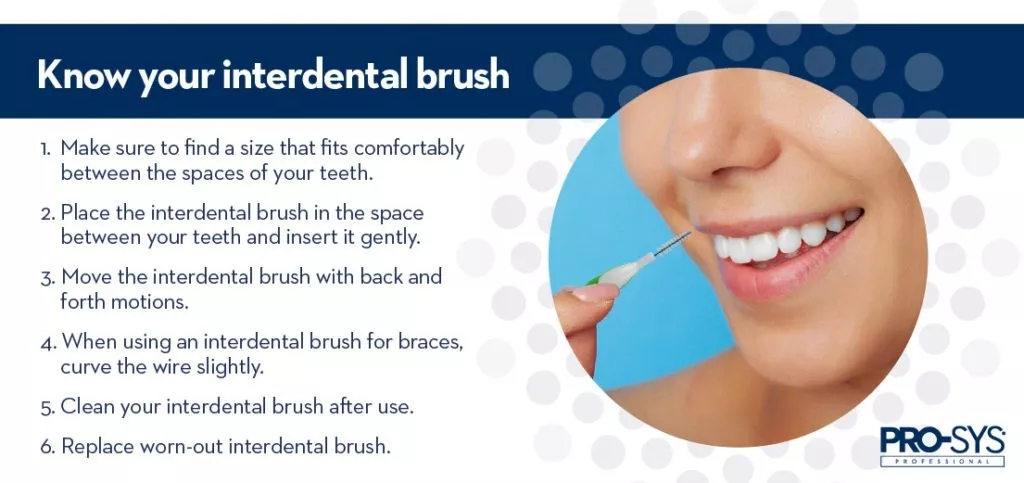
How to use an interdental brush
  1. Make sure to find a size that fits comfortably between the spaces of your teeth. You may need more than one size for different areas of your mouth. If you need help picking them out, ask your dentist for recommendations.
  2. Place the interdental brush in the space between your teeth and insert it gently. Please don’t force it into a tight space. If it genuinely doesn’t fit, consider using a smaller-sized brush.
  3. Move the interdental brush with back and forth motions. This step will help loosen and clean away the food debris that has accumulated or gotten stuck in that area.
  4. When using an interdental brush for braces, curve the wire slightly. Angling the brush can help you get in between the brackets and wires, ensuring a more thorough clean.
  5. Clean your interdental brush after use. Use water to wash out any food residue left on your dental brush. Doing this after every use will help keep the bristles in good condition.
  6. Replace worn-out interdental brush. Using a worn-out dental brush is not recommended because the device may lose its effectiveness.

When you first start using an interdental brush, your gums may bleed a little. According to the National Health Service, the bleeding should diminish once your gums start getting healthier. However, if the problem persists after a few days, reach out to your dentist for advice.

When to Replace an Interdental Brush

An interdental brush should be in perfect shape for optimal cleaning results, meaning the bristles should be intact. Once you notice that the filaments of your interdental toothbrush have become worn out, that would be the best time to replace them. Some dentists may recommend replacing them once a week if you have trouble checking whether the bristles are still in good shape.

Find the Best Interdental Brush for Your Needs

Ready to take charge of your oral health? To clean the areas of your mouth that a regular toothbrush can’t reach, a quality interdental brush such as the one offered by PRO-SYS can be the perfect tool. 

This brush is tough on plaque but gentle on your teeth and gums with its stainless steel bristles and cylindrical design. Experience the thorough clean this interdental brush can provide today!


A Complete Toothbrush Guide for Every Age Group: How to Choose the Best Toothbrush for Toddlers, Kids, Teens, and Adults

Dental health is essential throughout the lifetime, from infancy to late adulthood. People from different stages of life also have varying oral hygiene needs. The electric or manual toothbrush that works for an adult, for instance, may not necessarily be best for your little one.

If you need help finding the best toothbrush for babies, toddlers, kids, teens, or adults, this article can steer you in the right direction. Let’s navigate the ins and outs of oral care with this complete toothbrush guide for every age!

How to Choose the Right Toothbrush for Different Stages of Life

The Best Toothbrush for Babies: 0-2 Years Old

Caring for an infant’s teeth as early as possible is the key to a lifetime of good dental health. The American Dental Association tells us that not brushing baby teeth can lead to oral health problems down the road. 

Additionally, the ADA cites that when an infant’s tooth falls off too early, permanent adult teeth can grow prematurely, causing them to become crooked or crowded. These problems can be avoided by regularly using a toothbrush for babies.

What to Choose

A finger toothbrush can be the ideal option for babies who do not have teeth yet or are starting to grow teeth. This baby toothbrush can fit over a parent’s or other adult’s finger and swipe away bacteria from the baby’s gums, helping make sure that their teeth grow in a healthy environment. Make sure to choose from quality brands that offer ADA-accepted and dentist-recommended products.

If your little one is resisting your efforts to brush his teeth, try a baby toothbrush that also functions as a teether. Keeping your baby’s smile happy and healthy has never been this easy!

The Best Toothbrush for Toddlers: 3-5 Years Old

By the time a child grows out of the baby stage, their brushing routine will need to be done twice a day (in the morning and the evening). You can start letting your toddler help clean their teeth by the time they turn 2 years old. 

However, don’t give them complete independence just yet. Until your child turns about 6 to 8 years old, they will still need adult supervision and guidance while using their toothbrush for toddlers.

What to Choose

Toddlers can be picky when it comes to what gets placed in their mouths. One good way to get them invested in their oral hygiene is by letting them help choose their toothbrush. 

Ideally, a good toothbrush for toddlers will have a small head to easily and comfortably fit in your child’s mouth. Soft bristles for your little one’s sensitive teeth are also a must. Let your toddler pick a toothbrush with their favorite color or pattern so they’ll feel excited to brush!

The Best Toothbrush for Kids: 6-8 Years Old

Cavities are among the most common conditions found in children in the U.S. According to the Centers for Disease Control and Prevention, about 1 in 5 children between the ages of 5 and 11 have a decayed tooth. If left untreated, the cavity-ridden tooth can cause kids to experience pain or even lead to problems with eating, speaking, or playing.

The good news is that childhood oral diseases like cavities are entirely preventable. By regularly using a kids’ toothbrush, these young children can keep their teeth and gums healthy.

What to Choose

Around the ages of 6 to 8, children can start becoming more independent in their brushing routine. The ideal toothbrush for kids in this age range will begin to reflect that growing independence. 

Child-friendly brush designs would include handles that are easy for a child to grip and control and bristles that are soft and gentle on their gums. A bonus feature would be if the kids’ toothbrush also comes in different, fun colors!

The Best Toothbrush for Pre-Teens: 9-12 Years Old

Once a child turns 9 years old, they start becoming fully independent in their brushing routine. Parents no longer need to keep supervising their kids and instead allow them the freedom to establish their oral hygiene habits as they move closer to their teen years.

The pre-teen stage is also when most of your young one’s adult teeth will start coming in. According to the ADA, a child will have all 28 of their permanent teeth by the time they reach 13 years old. During this transitional stage, the type of kids’ toothbrush your child uses will likely also need to be changed.

What to Choose

Although pre-teens can still choose to use a toothbrush for kids, many in this life stage start shifting to a toothbrush for adults since most of their permanent teeth have already come in. If your pre-teen is tired of their old manual kids’ toothbrush, perhaps this is the best time to introduce them to the electric toothbrush.

The Best Toothbrush for Teens: 13-17 Years Old

Adolescence is a life stage that includes so many physical, emotional, mental, and social changes. As such, teenage dental health is significantly different from those of toddlers and young children. 

The American Academy of Pediatric Dentistry finds that teenagers are at an increased risk for caries, periodontal diseases, and other oral infections because of their unique psychological and social needs. Adolescents should then be encouraged to never neglect their dental health by regularly visiting a dentist and using a toothbrush for teens in their daily routine.

What to Choose

Unlike young children, teenagers now have far more toothbrush options to choose from. Adolescents can still use a manual toothbrush, but many in this age group also opt for an electric toothbrush because it can be more fun and easier to use. 

Since the teenage years are also when many start wearing braces or other orthodontic appliances, adolescents may also need to be introduced to interdental brushes and water flossers. These oral care devices, used alongside a regular toothbrush for teens, will make it easier for them to clean between the spaces of their teeth.

The Best Toothbrush for Adults: 18-64 Years Old

Practicing proper oral hygiene habits is critical throughout your lifetime, including early to late adulthood. The CDC found that nearly half (46%) of all adults have gum disease, while 26% have untreated tooth decay. Given this, adults must make it a point to stay on top of their dental health.

What to Choose

There are plenty of available toothbrushes for adults, whether you’re looking for a manual toothbrush or an electric one. The key is to find a trusted brand that offers premium-quality toothbrushes that meet your specific needs in this stage of life.

The Best Toothbrush for Seniors: 65 Years Old and Above

Older adults (aged 65 and above) were found to have an increased risk for dental conditions like periodontitis, caries, and xerostomia, according to the ADA. Since many physical, mental, and sensory impairments occur due to aging, some older folks may have difficulty maintaining optimum dental health. Thankfully, the right toothbrush for adults can make a world of difference for these seniors.

What to Choose

Instead of picking just any toothbrush for adults, a senior may need one that is more attuned to their health needs. For instance, many older people have very sensitive teeth and gums, so they may need a specially designed toothbrush for adults with extra-soft bristles. An easy-to-grip brush handle is also required since many seniors struggle with physical limitations.

The ADA also recommends using an electric toothbrush, especially for seniors with disabilities that affect their mobility or cognitive impairments that affect their focus. The right battery-powered brush can make it much easier for them to maintain good oral health.

Find Your Ideal Toothbrush With Help From PRO-SYS!

Picking the toothbrush that works best for you is the first step in keeping your teeth and gums healthy. Your next move should now be to buy your perfect toothbrush and use it to stay on top of your oral hygiene. No matter how old you are, PRO-SYS is bound to have a brush that can address your oral care needs. Learn more about our dentist-recommended products!

Electric vs. Manual Toothbrush: Which Works Better?

Achieving and maintaining good oral hygiene starts with brushing your teeth regularly. As such, it’s natural to want nothing but the best toothbrush available to help keep your smile as beautiful and healthy as possible. 

The American Dental Association says that both electric and manual toothbrushes are safe and effective at cleaning teeth. However, people have varying dental needs, and depending on your specific situation, one toothbrush may offer more benefits than the other. 

If you can’t decide which toothbrush you need, don’t fret. In this article, we’ll break down the advantages and disadvantages of electric vs. manual toothbrushes.

Electric vs. Manual Toothbrush: Should I Switch to an Electric Toothbrush From a Manual One?

“Should I switch to an electric toothbrush from a manual one?” This is a question that many people find themselves asking. Before you take that leap, learn about the differences between a manual and an electric toothbrush and see which one works better for you.

Control

For people who like having more control over their brushing process, a manual toothbrush can be the better choice. An electric toothbrush has rotating brush heads, quick-vibrating bristles, and built-in timers, which may make some feel as though they are giving up control over how much pressure to use or how long they wish to keep brushing a particular area of their mouth.

Additionally, an electric brush only has a few set cleaning powers, and some may need to use less pressure than the minimum available setting. So, using a manual toothbrush can be better for those with sensitive teeth because they can quickly stop or apply less pressure whenever they feel a twinge of discomfort while brushing.

Which Works Better? MANUAL TOOTHBRUSH

Ease of Use

One of the main advantages of using an electric toothbrush is that it does most of the work for you and can be much easier to use. With its built-in timer and rotating brush heads, an automatic toothbrush can make the experience of brushing less of a hassle for people with limited mobility, such as those with carpal tunnel, arthritis, or developmental disabilities.

A research study from the National Institutes of Health also found that people with orthodontic appliances, such as braces, may find it easier to use an electric toothbrush than a manual one. Orthodontic patients with initially poor oral hygiene, primarily, benefited most from using electric toothbrushes.

Which Works Better? ELECTRIC TOOTHBRUSH

Better for Seniors

If you’re looking to buy a new toothbrush for your elderly parent or grandparent, a manual brush may be the better choice. In a clinical trial about the effect of manual and electric toothbrushes on the dental hygiene of folks from nursing homes, more than half (54%) of the seniors reported preferring non-electric toothbrushes. There was also no significant difference between the plaque score of those who used manual brushes and those who used electric.

However, bear in mind that this still depends on the capabilities of the senior. The ADA cites that older adults with mobility issues or cognitive impairments may find it easier to use an electric toothbrush.

Which Works Better? MANUAL OR ELECTRIC TOOTHBRUSH (DEPENDING ON THE SENIOR)

More Fun for Kids

Although children can use manual and electric toothbrushes, many kids find it more fun to use an automatic brush. If you’re struggling to get your little ones invested in their dental hygiene, buying them an electric toothbrush can help get them excited about brushing.

Which Works Better? ELECTRIC TOOTHBRUSH

Improved Focus

Some people have difficulty focusing while brushing their teeth, leading to areas of their mouth becoming neglected. To avoid this, using an automatic toothbrush can be the ideal solution. Since an electric toothbrush comes with a built-in timer, you can quickly know when it’s time to cease brushing one area of your mouth and move on to the next, ensuring a more thorough clean.

A study by the NIH confirms these benefits, citing that electric toothbrush users were found to brush in a more concentrated and focused pattern than those who used manual brushes.

Which Works Better? ELECTRIC TOOTHBRUSH

Accessibility

One of the most notable advantages that a manual toothbrush has over an electric one is that it is more accessible. Unlike an automatic brush, which needs to be charged to function, a non-electric toothbrush can be used anywhere and at any time. Also, manual toothbrushes are typically available in convenience stores and other shops, making them easier to find and purchase during an emergency.

Which Works Better? MANUAL TOOTHBRUSH

Cost

The price of a manual toothbrush is significantly more affordable for the average person. An electric toothbrush not only has a higher price but also requires batteries and multiple replacement brush heads (the head will need to be changed every 3 months), which are an additional cost to consider when shopping for your ideal brush.

Which Works Better? MANUAL TOOTHBRUSH

Stay on Top of Your Oral Health, No Matter the Brush!

Now that you understand the advantages and disadvantages of manual and electric toothbrushes, it’s time to assess which brush is right for you. Whether you’re a person with sensitive teeth who prefers a non-electric brush or an orthodontic patient in need of an automatic toothbrush, PRO-SYS can offer just what you need. Learn more about our various dentist-recommended products!

Got a New Manual Toothbrush? Here Are 10 Must-Know Tips to Maximize Its Use!

Brushing your teeth is an essential part of your daily routine. Your toothbrush is your most excellent defense against tooth decay, gum disease, and other oral infections. For this reason, it’s crucial to make sure that you’re getting the most use out of it.

Statistics show that about 264.98 million Americans use a manual toothbrush, but not all understand the best practices for using one. In this infographic, we’ll illustrate the best tips to maximize your toothbrush, which, in turn, will improve your overall oral health!

Top 10 Proven Tips to Maximize Your Toothbrush’s Use

10 Tips to Maximize Manual Toothbrush

Start Getting the Most Use Out of Your Manual Toothbrush Today!

Now that you’re equipped with these helpful tips to maximize your toothbrush, it’s time to put this knowledge into action. Making the most out of your daily brushing routine means setting yourself up for a lifetime of good dental health.

Since your smile deserves nothing but the best care, find an ADA-recommended manual toothbrush that’s guaranteed to be safe and effective. The various toothbrushes offered by PRO-SYS have all of these qualities and more. Let us help you keep your teeth healthy and happy!

Caring for Your Baby’s Teeth: ‘How Do I Use a Finger Toothbrush for Babies?’ and Other Important Questions

A baby’s smile is the most precious sight. If you think your little one is adorable now, wait until you see how cute they look with their first few teeth!

Your job is to make sure your baby has good dental hygiene even during the earliest developmental years. You may find this challenging or confusing. But, never fear. With this article, you can learn about the frequently asked questions parents have about caring for their little one’s teeth, including how to use a finger toothbrush for babies!

What You Need To Know About Caring for Your Baby’s Teeth: 7 Questions and Answers

Q#1: When will my baby’s teeth start coming?

A: According to the American Dental Association, an infant’s 20 primary teeth are already present in the jaw at birth. However, the teeth only start appearing through the gums once the child is about 4 to 6 months old. By the time a child is about 3 years old, they will likely already have a complete set of 20 primary teeth.

You will notice that your baby has started teething if they are showing these symptoms: 

  • Frequently fussy and crying
  • Drooling
  • Trying to chew and bite things
  • Bringing their hands to their mouth
  • Exhibiting a change in their sleeping or eating pattern
  • Having swollen and tender gums

One thing new parents should know: it’s never too early to start caring for your baby’s teeth. Even during the early stages of teething, parents can take steps to prevent tooth decay and gum disease in their little ones.

Q#2: How can I keep my baby’s teeth and gums healthy?

A: Practicing proper oral hygiene habits are essential even for infants. Parents can set their little ones up for a lifetime of good dental health by following these tips:

  • Avoid giving your baby sugary drinks. When bottle-feeding your baby, give them only plain water or milk. Repeated exposure to beverages such as sweetened water, soft drinks, or fruit juices can lead to tooth decay.
  • Do not share spoons with your baby. As much as possible, try to avoid situations where your infant’s mouth can come in contact with your saliva. 
  • Always use a clean pacifier. Some parents dip pacifiers in sugar and honey to get their babies to latch on, but this is not recommended and could lead to teeth and gum problems. At the same time, some pediatricians recommend skipping the pacifier altogether. You may want to check your doctor’s stand on this debate. 

Use a baby toothbrush. This step is the most critical. It would be best if you clean your little one’s teeth twice a day with a finger toothbrush for babies. Doing so will help your child avoid oral infections and learn proper hygiene habits as early as possible.

Q#3: What should I use to clean my baby’s teeth?

A: When your child’s first teeth start to pop up, this is the best time to start using a finger toothbrush for your baby. A finger toothbrush is a small brush that fits over an adult’s finger and is specially designed to clean babies’ teeth. Typically, these toothbrushes have extra-soft bristles for the comfort and safety of your baby’s sensitive mouth.

Q#4: When should I start using a finger toothbrush for my baby?

A: You can use a finger toothbrush for babies even if your little one doesn’t have teeth yet or is only starting to have teeth. By introducing them to a baby toothbrush early, their teeth will have a healthy environment to start growing in, and their gums will be free of harmful bacteria.

Q#5: How do I use a finger toothbrush for my baby?

A: If you don’t quite understand how to use a baby finger toothbrush to clean your little one’s teeth, here are the steps you can follow:

  • Use a clean washcloth to wipe your baby’s gums. Be gentle as you wipe, and don’t neglect the area under the lip region. Doing this will help reduce bacteria buildup in your child’s mouth.
  • Wet the finger toothbrush for babies by soaking it in warm water for a few minutes. This step is essential for softening the bristles further.
  • Use a toothpaste amount that’s the size of a grain of rice. According to the American Academy of Pediatrics, using this amount of toothpaste is recommended until your child is about 3 years old.

Encourage your child to spit out the toothpaste after brushing. Fluoride is safe for children, but they should still avoid ingesting it. Consuming more toothpaste than the recommended amount can lead to an upset stomach.

Q#6: Why is it essential to use a finger toothbrush for my baby?

A: Cleaning your child’s teeth with a baby finger toothbrush is vital for keeping up their oral hygiene. The Centers for Disease Control and Prevention reports that cavities are among the most common childhood chronic diseases in the U.S., affecting about 1 in 5 (20%) young children. Thankfully, daily brushing was found to reduce the prevalence of cavities and other oral infections.

Taking care of your baby’s teeth can also help protect your child’s oral health even throughout adulthood. According to the ADA, when a baby’s tooth falls off too early, adult teeth can fill the space, making it harder for other permanent teeth to grow and find room within the mouth. Cleaning your child’s teeth regularly with a finger toothbrush for babies can help prevent future teeth from growing crooked or crowded.

Q#7: Aside from using a finger toothbrush for babies, how can I help my infant with teething?

A: Babies can often become irritable while teething. The discomfort of their growing teeth may cause them to cry more often and have difficulty eating or sleeping. In addition to caring for your baby’s teeth, there are ways you can help lessen your little one’s irritation during this stage. Here are some suggestions:

  • Set and maintain a consistent routine. Parents can help relieve their baby’s discomfort during teething by sticking to a constant eating and sleeping schedule. The routine will allow the child to feel more comfortable and safe despite the changes they are experiencing.
  • Use a chilled washcloth. You can place a wet washcloth in the freezer until it’s chilled but not frozen, and then give it to your child to chew on. Another option is to use the washcloth to massage your baby’s gums. Washcloth helps relieve the areas of their mouth where they are experiencing discomfort.

Give your child teethers or toys. Another way of helping ease your baby’s teething pains is by using teethers or toys that they can chew on. If you’re looking for a teether that also functions as a baby toothbrush, PRO-SYS has the product.

Discover the Wonders of the PRO-SYS 2-in-1 Baby Teething Brush!

Taking care of a baby’s dental health, especially when they’re selective about what gets placed in their mouth, is no easy task. Thankfully, keeping your little one’s teeth clean doesn’t have to be such a chore when you have the PRO-SYS Dual Baby Toothbrush

This 2-in-1 brush can be the ideal tool for parents with sweet yet fussy little ones, combining the functionality of a finger toothbrush for babies with the comfort and fun of a teething toy. Whether you’re at home or on the go, you can keep your baby entertained and calm without sacrificing their oral hygiene. Learn more about how this baby toothbrush can benefit you and your family!

How To Floss: A Step-by-Step Guide on Flossing Properly Before or After Brushing

Most people know that daily brushing is essential to their dental health. However, some still neglect the importance of flossing. A survey conducted in consultation with the American Dental Association found that 44% of people admit to exaggerating how much they floss when asked by their dentist

In reality, however, it was found that:

  • only a few people floss daily (16%)
  • most people only floss when there is food debris between their teeth (20%)
  • some people never floss (8%)

The common reasons why some choose not to floss: They don’t know why it’s needed. They don’t know how to do it properly. 

This article will discuss why flossing before or after brushing is vital to help you stay on top of your oral health. More importantly, there is a step-by-step guide on how to floss safely and effectively.

The Importance of Flossing in Keeping Up Your Dental Hygiene

Imagine this: You just had a lovely dinner, eating your favorite meal with your loved ones. However, you feel some discomfort, finding something off with your mouth. 

You checked the mirror and realized that leftovers have gotten stuck between your teeth. How do you get them out?

Many Americans use unusual items to remove food stuck between their teeth: pieces of paper, fingernails, cutlery, safety pins, and even strands of hair. This finding is from the same survey from the ADA that found adults exaggerating answers as to how frequent they floss

Using those items for this purpose can hurt your teeth and gums and increase the spread of bacteria in your mouth. Thankfully, there is a safer and more effective tool for this problem: dental floss. 

When you floss regularly, you can prevent gum disease, cavities, and other oral infections. Floss can clean hard-to-reach areas between your teeth and remove trapped food debris before they harden into plaque. Research studies cited by the National Institutes of Health mentioned those benefits as well, noting that flossing alongside brushing teeth reduces risk of gingivitis and plaque build-up compared to brushing alone.

How To Floss Properly in 7 Easy Steps

Now that you understand why it’s important to floss, your next move is to learn how to do it safely and effectively. Here’s how you can get started:

#1: Pick a time of day to include flossing in your daily routine.

The ADA recommends flossing at least once a day. You can choose to do this whenever it fits your schedule, as long as you make it part of your daily oral care routine. 

Some choose to floss after brushing, while others prefer doing it before. However, flossing first is generally recommended because the floss will loosen the food debris stuck between your teeth. The brushing motions can then thoroughly remove the released particles from the mouth.

#2: Take about 18 inches of dental floss.

Eighteen inches gives you enough string to be able to use a new section for each space between your teeth, helping you avoid spreading food debris around as you use the floss.

#3: Break off the floss and wind most of it around your middle fingers.

The remaining dental floss can be wound around the same finger of your opposite hand. You can use this finger to take up the floss as it accumulates dirt from between your teeth.

#4: Grip the floss tightly between your fingers.

Use your thumb and forefinger to hold the dental floss so that you can grasp it more easily.

#5: Slip the floss between your teeth gently.

Don’t ever snap the floss into your gums. With a light touch, guide the floss between the space as far as it’ll go, making sure it reaches the gum line. Once this is done, use it to form a “c” shape and rub it against one tooth.

#6: Move the floss against the side of the tooth.

While holding the floss tightly, move it away from the gum, rubbing the side of the tooth with up and down motions. To fully dislodge food and plaque, use about 8 to 10 strokes between each tooth.

#7: When you’re done, discard the floss.

The ADA does not recommend using a floss strand more than once. Used floss loses its effectiveness. Worse, it actively deposits more bacteria into the mouth.

If you’ve tried these steps and are still finding it difficult or painful to floss, consult your dentist. They may recommend alternative options to string dental flosses, such as water flossers or interdental brushes.

Start Using Floss in Your Daily Oral Care!

Flossing can be challenging when you don’t know how to do it properly, but now that you have these helpful tips, it can be a breeze. Take charge of your dental hygiene by choosing extra-strong flossers and picks, such as the ones offered by PRO-SYS

No matter how tight the spaces between your teeth, these flossers can get the job done without bringing you any pain or discomfort. Experience the difference that using quality floss can have on your teeth and gum health today!

Using an Interdental Brush for Braces: A Guide to Brush Sizes, Cleaning, and Care

More than 4 million people wear braces worldwide, and 25% are adults in the United States. Given how common this orthodontic treatment is, it is crucial to know how to clean and maintain this dental appliance. Many people with braces find it hard to remove the food debris around their teeth, brackets, and wires. 

In this article, you will learn about the importance of keeping your teeth and braces clean. Find out how an interdental brush can benefit you, and discover what brush size is right for you.

Importance of Proper Oral Care During Orthodontic Treatment

Despite how valuable braces are for those with crooked teeth, uneven bites, overbites, and underbites, wearing them can make dental care slightly more complicated. Braces are wire-based orthodontic appliances used to correct misaligned teeth or jaws. Food and other debris can often get stuck between the bracket and wires, leading to plaque buildup and oral infections if left untreated.

The American Association of Orthodontics (AAO) states that cooperation between patients and dentists is vital for maximizing the benefits of wearing braces. Those with the dental appliance can help ensure the success of this orthodontic treatment by limiting sugary drinks, visiting the dentist every 3 to 6 months, and keeping their teeth clean.

Using a regular toothbrush, however, is often not enough for those undergoing this orthodontic treatment. To prevent teeth and gum infection, people with braces should consider using an interdental brush as part of their daily oral health routine.

What Is an Interdental Brush?

An interdental brush is a small brush designed to clean the spaces between teeth that a traditional toothbrush cannot reach. Although there are many ways to use an interdental brush, it is especially beneficial for people with braces and other orthodontic treatment appliances. 

There are various types of interdental brushes that come in assorted sizes to fit different-sized gaps between teeth. Typically, an interdental brush has a filament held in place by a metal wire that can be angled or bent, making it easier to maneuver around brackets and wires. Some interdental brushes are disposable, while others have handles for long-term use but would need replacement brush heads.

How to Choose the Interdental Brush Size That Is Best for You

Different Interdental Brush Sizes

“What is the best interdental brush size to use for braces?” This question is important to ask before you rush out and buy one for yourself. The ideal interdental brush should fit comfortably between the gaps of your teeth. If the size is too small, the bristles won’t clean effectively. When the brush size is too big, you may end up damaging your teeth and gums.

According to Dentaly.org, there is an ISO sizing standard for numbering interdental brushes from 0 to 8 (ranging from 0.4 mm to 1.5 mm). However, not all manufacturers follow this. Different types of interdental brushes are typically color-coded to make it easier to tell sizes apart.

Suppose you’re looking for the best interdental brush size for braces. DentistryIQ cites that the medium-sized brushes may be the most suitable for cleaning under the orthodontic wire and around brackets. For more help choosing the interdental brush size for your specific needs, reach out to your dentist. They will typically measure the spaces between your teeth and advise you on which brush size to use.

Another good option is using an angled brush. People with braces may find these interdental brushes to be simpler to use because these typically have longer handles, making them easier to grip, and pre-angled heads that provide better access to the back of the mouth.

How to Use an Interdental Brush for Cleaning Teeth and Braces

Now that you understand the answer to “what is the best interdental brush size to use for braces?” your next move is to learn how to use one safely and effectively. Here are a few tips to follow as you use your interdental brush for the first time:

  1. Gently place the interdental brush into the space between your teeth.
  2. Twist the brush slightly as you press it in for easier insertion.
  3. Brush backward and forward several times. (Ask for your dentist’s advice on how many strokes to do.)
  4. Remove the brush and move onto the next gap.
  5. When your brush breaks or gets worn out, discard it and use a brand-new one.

Keep Your Teeth and Braces Clean With an Interdental Brush!

Understanding how to choose the right interdental brush size for braces is important to stay on top of your oral health. Now that you’re equipped with this information, it’s time to take the next step and get yourself a quality interdental brush, such as the one offered by PRO-SYS

Designed for narrow spaces and gentle on the gums, this interdental brush can be the ideal addition to your daily dental care routine while you’re undergoing orthodontic treatment. Take charge of your oral health with our dentist-recommended products!